Vice City Then and Now: 2002's Neon Classic Meets Leonida in 2026
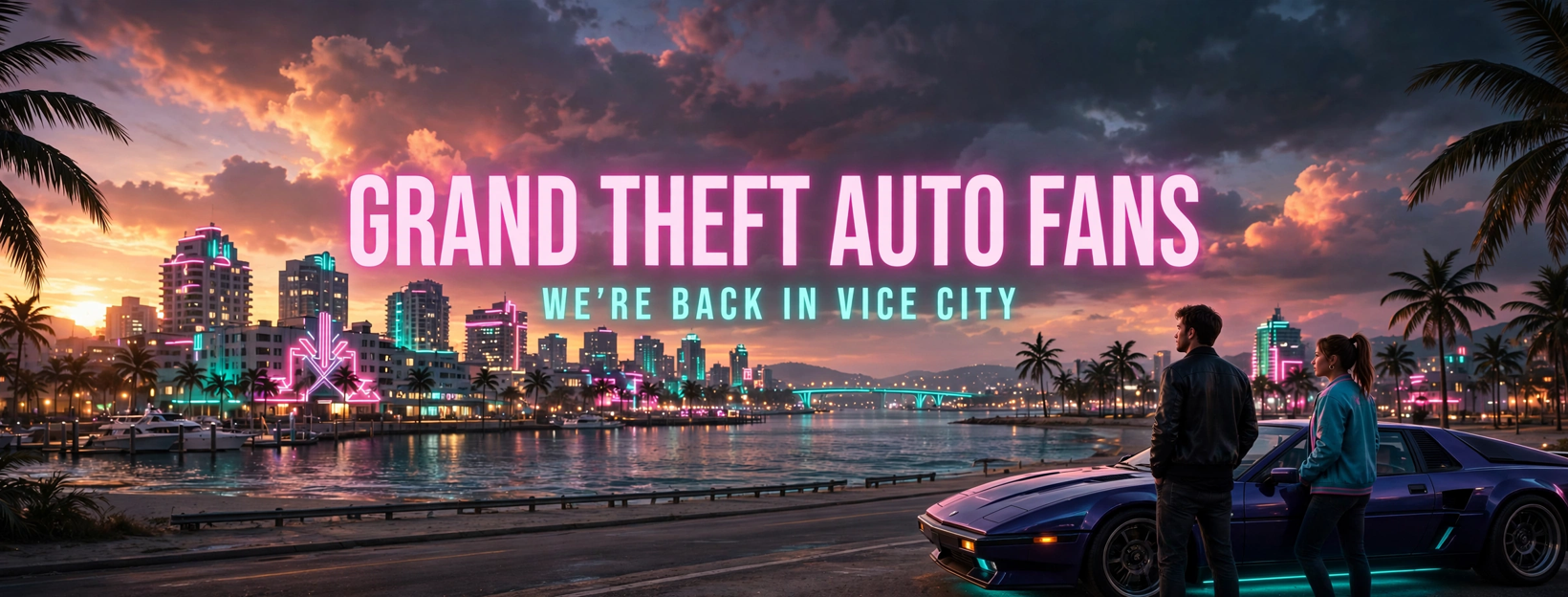
There is a generation of players for whom the words Vice City do not mean a place in a new game. They mean 2002, a PlayStation 2, and the opening of a story set in 1986: Tommy Vercetti, fresh out of prison after 15 years, sent south by Sonny Forelli and ambushed at a drug deal gone wrong. Grand Theft Auto: Vice City launched in October 2002 and became the best selling game of its year. This month, 24 years later, we finally went back.
Then: a city that felt like a film
The original Vice City was a love letter to a very specific fantasy of Miami: neon on Ocean Drive style hotels, beaches, swamps at the edges, and a soundtrack that did half the acting. It was the series' first fully voiced protagonist, with Ray Liotta giving Tommy a simmer that matched the pastel and chrome around him. The city was, by modern standards, small. It did not matter. It had a mood so strong that players can still hum the radio stations.
What the 2002 game really sold was tone. Big hair, excess and pastel suits, as its own box put it. You were not just playing a crime story, you were on holiday inside one.
Now: a city that became a state
GTA 6 keeps the city and hands it a whole state to grow into. Vice City is now one part of Leonida, Rockstar's fictional Florida, and the first week stories say it all: players spending 10 hours in the game without even reaching the city, because the keys, the towns and the wild country in between keep getting in the way. Where Tommy's story was a rise to power in one city, Jason and Lucia's story plays out across a map that critics have praised for its sheer density, on the way to a 99 score on Metacritic.
The echoes are deliberate and everywhere. The neon is still there, but so is the modern world the original could not have imagined: this is a Vice City of social media clips and viral moments, where a dog on a jet ski becomes famous by lunchtime. The radio, always the soul of Vice City, now reportedly runs to more than 1,500 tracks with artists hosting stations, including PinkPantheress on Stockyard FM. In 2002 the radio made the city feel alive. In 2026 it is one of the ways the city talks back.
What returning feels like
For returning fans, the strangest pleasure is the double vision. You drive a beachfront road and see two cities at once: the one in front of you, enormous and reactive, where a woman phones the police while you burgle her house, and the one in your memory, where the same coastline was a backdrop you could cross in minutes. Both are real. The 2002 game taught a generation what an open world could feel like. The 2026 game is what that promise grew into. Welcome back to Vice City. It kept your seat, and then it built a state around it.